Wolverine Stack Dosage
Wolverine Stack dosage has no established or approved human amount. What a laboratory needs is reconstitution math, and this page gives it, with a sliding calculator for Wolverine Stack vials.
Wolverine Stack dosage: what the word means for a research material
BPC-157 and TB-500 are not approved drugs. That means there is no FDA labeled dose, no approved route of administration, and no established safe amount for any person. The figures that circulate online come from animal and cell studies or from unverified forum posts, and animal amounts do not convert to human amounts. Wolverine Blend does not recommend, and will not publish, amounts for use in people or animals.
What a laboratory does need is arithmetic. How concentrated is the solution after reconstitution, how much volume holds a chosen amount of material, and where does that volume land on a syringe scale. The calculator below answers those three questions.
Wolverine Stack dosage calculator for lab reconstitution
Wolverine Stack Dosage Calculator for Lab Reconstitution
A volume and concentration calculator for preparing research aliquots in a laboratory. It does not recommend an amount and is not a dose calculator for people or animals.
Assumes a 1:1 mass ratio blend (10 mg of each compound in a 20 mg vial). Verify against your vial label and COA. For laboratory use only.
How the reconstitution math works
Every Wolverine Stack vial in the calculator is treated as a 1:1 blend by mass, so 20 mg of total peptide is 10 mg of BPC-157 and 10 mg of TB-500. Three formulas cover everything.
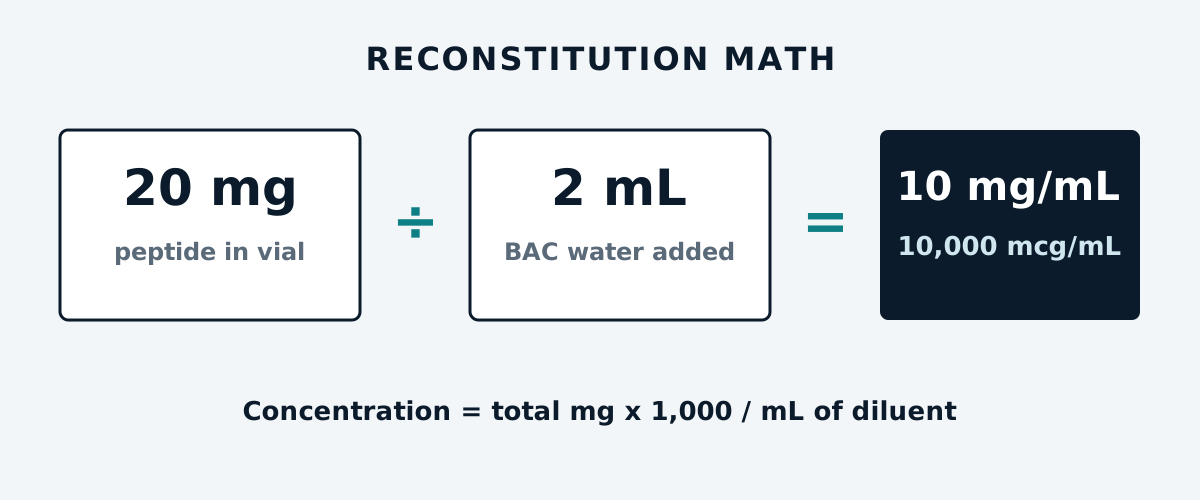
Concentration
Concentration in mcg per mL equals total mg times 1,000, divided by the mL of diluent. A 20 mg vial reconstituted with 2 mL of bacteriostatic water gives 20 x 1,000 / 2 = 10,000 mcg per mL, which is 10 mg per mL.
Volume for a chosen aliquot
Volume in mL equals the aliquot in mcg divided by the concentration in mcg per mL. For a round 1,000 mcg aliquot at 10,000 mcg per mL, the volume is 0.1 mL. This is arithmetic only and is not a suggested amount.
Syringe units
A U-100 insulin-style syringe is marked so that 100 units equal 1 mL. Multiply the volume in mL by 100 to find the marking. A volume of 0.1 mL sits at 10 units.
Wolverine Stack dosage chart: reconstitution table for a 20 mg vial
The table shows how the volume of diluent changes the concentration, and where a 1,000 mcg aliquot would sit. A larger volume of diluent gives a lower concentration and a larger volume per aliquot.
| Diluent | Concentration | Volume for 1,000 mcg | U-100 marking |
|---|---|---|---|
| 1 mL | 20,000 mcg/mL | 0.05 mL | 5 units |
| 2 mL | 10,000 mcg/mL | 0.10 mL | 10 units |
| 3 mL | 6,667 mcg/mL | 0.15 mL | 15 units |
| 4 mL | 5,000 mcg/mL | 0.20 mL | 20 units |
Which volume of diluent to use is covered in how much BAC water for Wolverine Stack.
Using the COA net content in the math
A vial labeled 10 mg and 10 mg does not always contain exactly that. Take a third-party report that measured 11.74 mg of BPC-157 and 9.78 mg of thymosin beta-4 in one vial. The measured total is 11.74 + 9.78 = 21.52 mg. Reconstituted in 2 mL of diluent, that vial is 21.52 x 1,000 / 2 = 10,760 mcg per mL in total, and it is no longer a 1:1 blend. Using the label number would put the concentration about 7 percent off.
That is the reason to work from the measured net content when you have a report for your lot, and why the per-compound lines in the calculator are only a label-based estimate.
Published research versus clinical use
Searches for Wolverine Stack dosage mostly return protocols written by sellers, coaches and forum users. Those are not clinical guidelines. Animal studies report amounts scaled to body weight and species, the studies use different routes, and none of that translates into an amount for a person. Human trial data on these peptides is sparse, which is why no regulator has issued a labeled dose.
Storage after reconstitution
Keep reconstituted solution refrigerated at 2 to 8 C and protected from light. Label every vial with the date and the concentration. Do not freeze and thaw a solution repeatedly. Use your own stability data to decide how long a solution stays in use, and discard it per your laboratory protocol.
Mistakes that skew the numbers
- Using the label amount instead of the measured net content from the COA.
- Mixing up mg and mcg. One mg is 1,000 mcg.
- Reading syringe units as mL. On a U-100 syringe, 10 units is 0.1 mL.
- Forgetting that the blend is two compounds, so each aliquot holds half of its mass as each peptide.
- Shaking the vial, which can foam the solution. Swirl gently instead.
Wolverine Stack dosage questions
Is there a recommended Wolverine Stack dosage?
No. There is no approved or established amount for people or animals, and we do not publish one.
Why does the calculator ask for an aliquot in mcg?
Laboratories prepare solutions by mass. The slider lets you set any mass and see the volume it occupies. It does not tell you what mass to choose.
Does the calculator work for other peptide vials?
Yes, for the concentration and volume math. The per-compound lines assume a 1:1 blend, so ignore them for a single peptide.
Keep reading: What is Wolverine Stack peptide, or how much BAC water for Wolverine Stack.