What Is Wolverine Stack Peptide?
Wolverine Stack peptide is the nickname for a blend of two research peptides, BPC-157 and TB-500, supplied as a freeze-dried powder for laboratory work. This page explains what is in the blend, what the name does and does not mean, and how to read the paperwork that comes with Wolverine Stack material.
What is the Wolverine Stack peptide blend?
The Wolverine Stack is a marketing name, not a scientific one. It borrows a comic book character's reputation for fast recovery and has no meaning in chemistry or pharmacology. In practice the Wolverine Stack is a combination of two peptides, BPC-157 and TB-500. The word "stack" only means that more than one compound is used together in the same protocol.
Suppliers sell the combination in two ways: as two separate vials, or as one vial that already holds both peptides. Wolverine Blend is the second kind. Each vial holds 10 mg of BPC-157 and 10 mg of TB-500, a 1:1 ratio by mass and 20 mg of total peptide.
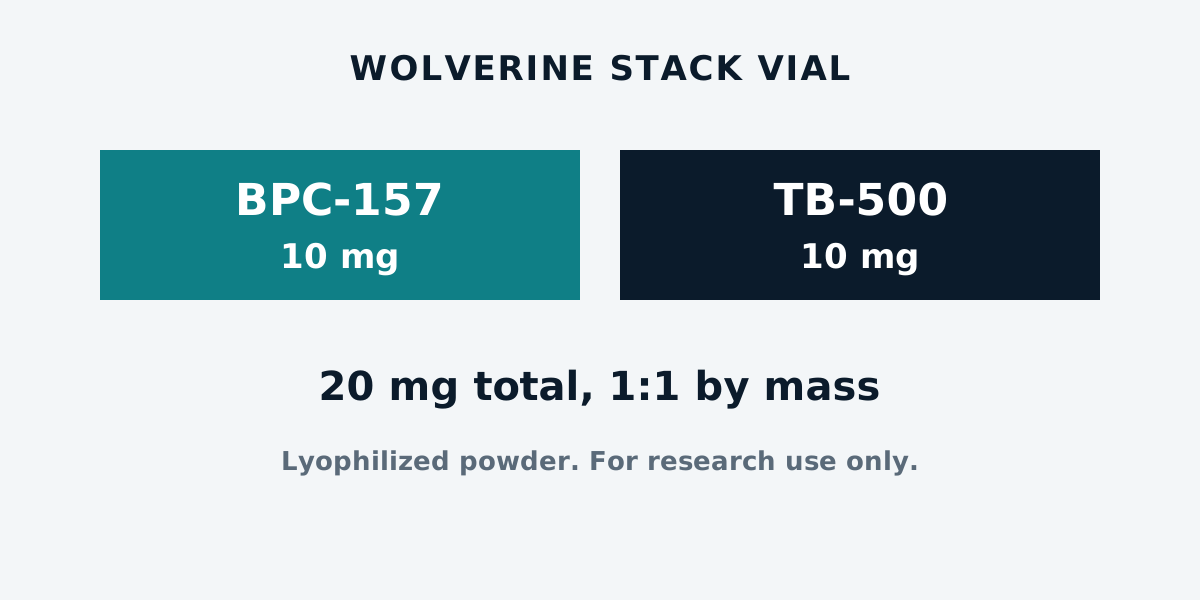
What is Wolverine Stack peptide made of? BPC-157 and TB-500
BPC-157 in the Wolverine Stack peptide blend
BPC-157 is a synthetic peptide made of 15 amino acids, which makes it a pentadecapeptide. Its sequence was taken from a protein fragment first described in human gastric juice, and the name stands for Body Protection Compound 157. It appears in a body of preclinical work, meaning cell culture and animal studies. It is not approved by the FDA as a drug for any use, and published human clinical data is very limited.
TB-500 and thymosin beta-4 in the Wolverine Stack peptide
Thymosin beta-4 is a naturally occurring peptide of 43 amino acids found in many cell types. TB-500 is the name used for a synthetic version related to it. It is also studied in preclinical models, it is not an approved drug, and it is prohibited in competitive sport.
What is Wolverine Stack peptide? Why the names cause confusion
Suppliers do not use "TB-500" in one consistent way. Some use it for a short synthetic fragment of thymosin beta-4, and others use it for the full-length peptide. The two are different molecules with different masses. The only reliable check is the identity line on the certificate of analysis for your lot, so read it before you assume what is in the vial.
Why Wolverine Stack peptides are sold as one blend
A laboratory that works with both compounds in the same experiment has to weigh, reconstitute, label and track two vials. A co-formulated blend cuts that to one vial and one lot number, which makes the handling more consistent from one run to the next. The tradeoff is a fixed ratio. If a protocol needs the two peptides in different proportions, separate vials give more control.
What a lyophilized vial contains
Lyophilized means freeze-dried. The peptide solution is frozen and the water is removed under vacuum, which leaves a dry white powder, often a small cake at the bottom of the vial. Peptides are far more stable as a dry powder than in solution, which is why research peptides ship this way.
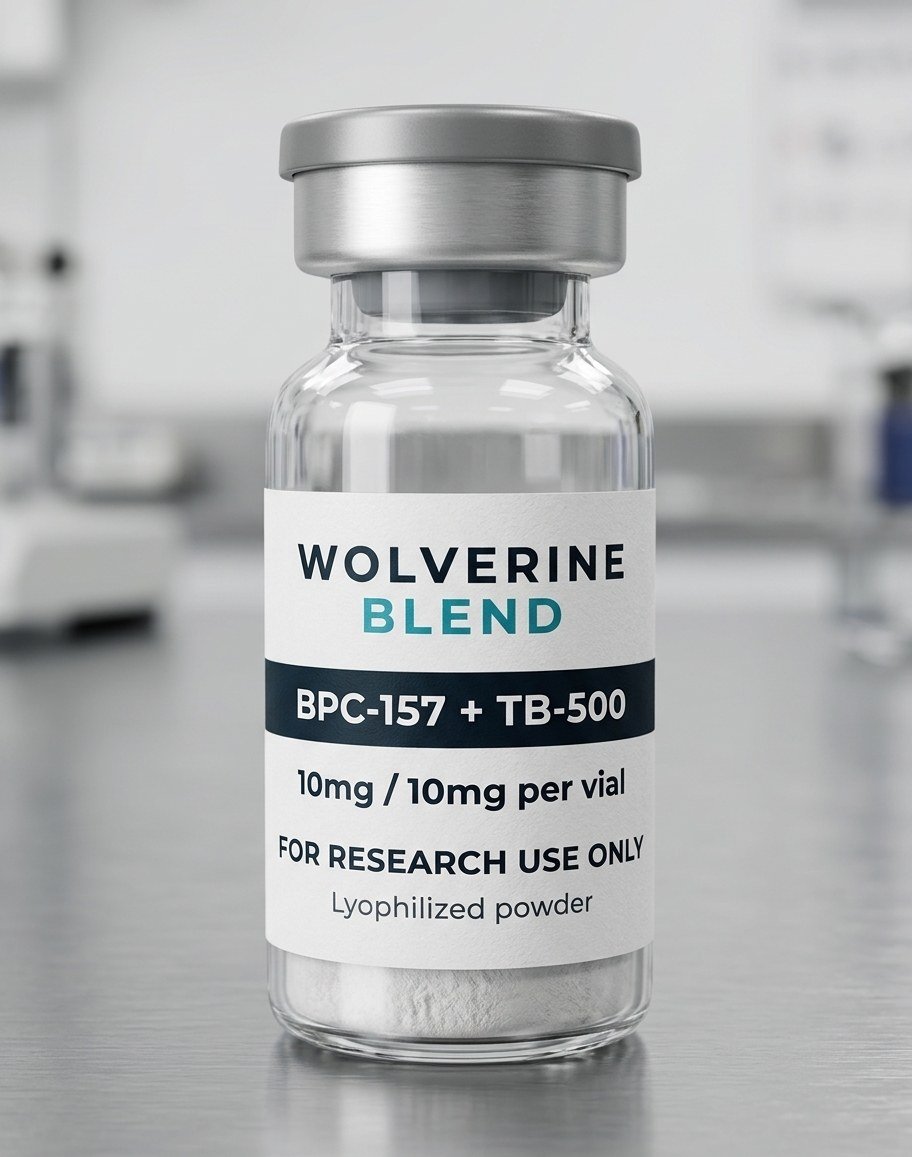
The powder has to be reconstituted with a diluent such as bacteriostatic water before it can be measured by volume. The reconstitution math is covered in the Wolverine Stack dosage and reconstitution calculator guide.
How to read a certificate of analysis
A certificate of analysis, or COA, is the lab report for a specific lot. Four lines matter most:
- Purity (HPLC): the share of the sample that is the target peptide, measured by high performance liquid chromatography.
- Identity (mass spectrometry): confirms the molecules in the vial have the expected mass. This is where a fragment and a full-length peptide are told apart.
- Net content: the measured milligrams of each peptide. It can differ from the label, so use the measured number when you do concentration math.
- Lot and lab: the lot on the report has to match the lot on your vial, and the report should name the testing laboratory.
Regulatory status of the Wolverine Stack
- Neither BPC-157 nor TB-500 is an approved human drug in the United States.
- The FDA has listed BPC-157 among bulk drug substances that may present significant safety risks for compounding, and it has sent warning letters to sellers who market these products for human use.
- Material sold for research must be labeled for research use only and cannot be marketed with disease claims or instructions for use in people.
- Both compounds are on the World Anti-Doping Agency prohibited list.
Rules change. You are responsible for confirming that your purchase and use are lawful where you are.
Handling and storage in the laboratory
Store the sealed, lyophilized vial at 2 to 8 C for the short term or at -20 C for the long term, away from light and moisture. Let the vial reach room temperature before opening so condensation does not enter. After reconstitution, keep the solution refrigerated, label it with the date and concentration, and follow your own stability data for how long it can be used.
Wolverine Stack peptide questions
Is the Wolverine Stack a drug?
No. It is sold as a research chemical and has not been approved by the FDA for any medical use.
Does the name mean the blend does something specific?
No. The name is marketing. Claims about what the blend does in a body are not supported by approved clinical evidence, and we do not make them.
Can I use Wolverine Stack on myself?
It is not sold for that, and we cannot advise on it. If you are asking about your own health, talk to a licensed physician or pharmacist.
What peptide does Joe Rogan take?
We do not comment on what any person uses. A public figure mentioning a peptide is not evidence that it is safe or that it does anything, and this site gives no guidance on use in people. Wolverine Stack is sold for laboratory research only.
What is the difference between a Wolverine Stack blend and two separate vials?
The compounds are the same. A blend gives you one lot and a fixed 1:1 ratio, and separate vials let you vary the ratio.
Keep reading: Wolverine Stack dosage and reconstitution calculator.